Recipe costing is arithmetic that most restaurants get wrong in the same places: yield, portion size and stale prices. This guide gives you a recipe costing template, column by column, then costs one dish end to end so you can copy the structure for your own menu. The columns below are the whole sheet; a spreadsheet or any recipe cost calculator will do the arithmetic.
The recipe costing template, column by column
One row per ingredient, seven columns, and a summary block underneath. Cells you type into are marked “input”; the rest are formulas.
| Column | Input or formula | What goes in it |
|---|---|---|
| A. Ingredient | Input | The name as it appears on the supplier invoice |
| B. Purchase unit | Input | kg, lb, case, each, litre: the unit you pay by |
| C. Purchase price | Input | The latest invoice price per purchase unit, e.g. $9.80 per kg |
| D. Yield % | Input | Usable share after trimming, peeling and cooking loss; 100% for items used whole |
| E. Usable cost per unit | Formula: C / D | What a usable kilo, each or litre costs you |
| F. Portion quantity | Input | What goes on one plate, in the same unit as B |
| G. Line cost | Formula: E × F | That ingredient’s share of the plate |
The summary block sits below the ingredient rows:
| Row | Input or formula |
|---|---|
| Allowance | Input: salt, pan oil, garnish; 2 to 4% of the ingredient lines |
| Plate cost | Formula: sum of column G, plus allowance |
| Menu price | Input |
| Food cost % | Formula: plate cost / menu price |
| Target food cost % | Input (see targets by dish type below) |
| Suggested price | Formula: plate cost / target food cost % |
Two rules keep the sheet honest: keep units consistent (pay by the kilo, enter the portion in kilos, or convert in column F), and date the price column so you know when the sheet was last true.
Yield is where the money hides
If you buy whole chickens at $3.60 per kg and only use the breast and thigh, your usable yield might be 55%. The real cost of the meat you serve is $3.60 divided by 0.55, which is $6.55 per kg. Costing the recipe at $3.60 understates the plate cost by 45% on that line.
Typical yields worth knowing:
- Whole chicken to breast and thigh meat: 50 to 60%
- Beef striploin, trimmed: 80 to 85%
- Salmon side, skin on, trimmed and portioned: 85 to 90%
- Onions, peeled: 88 to 90%
- Potatoes, peeled: 80 to 85%
- Avocado: 65 to 70%
- Lettuce, cleaned: 70 to 80%
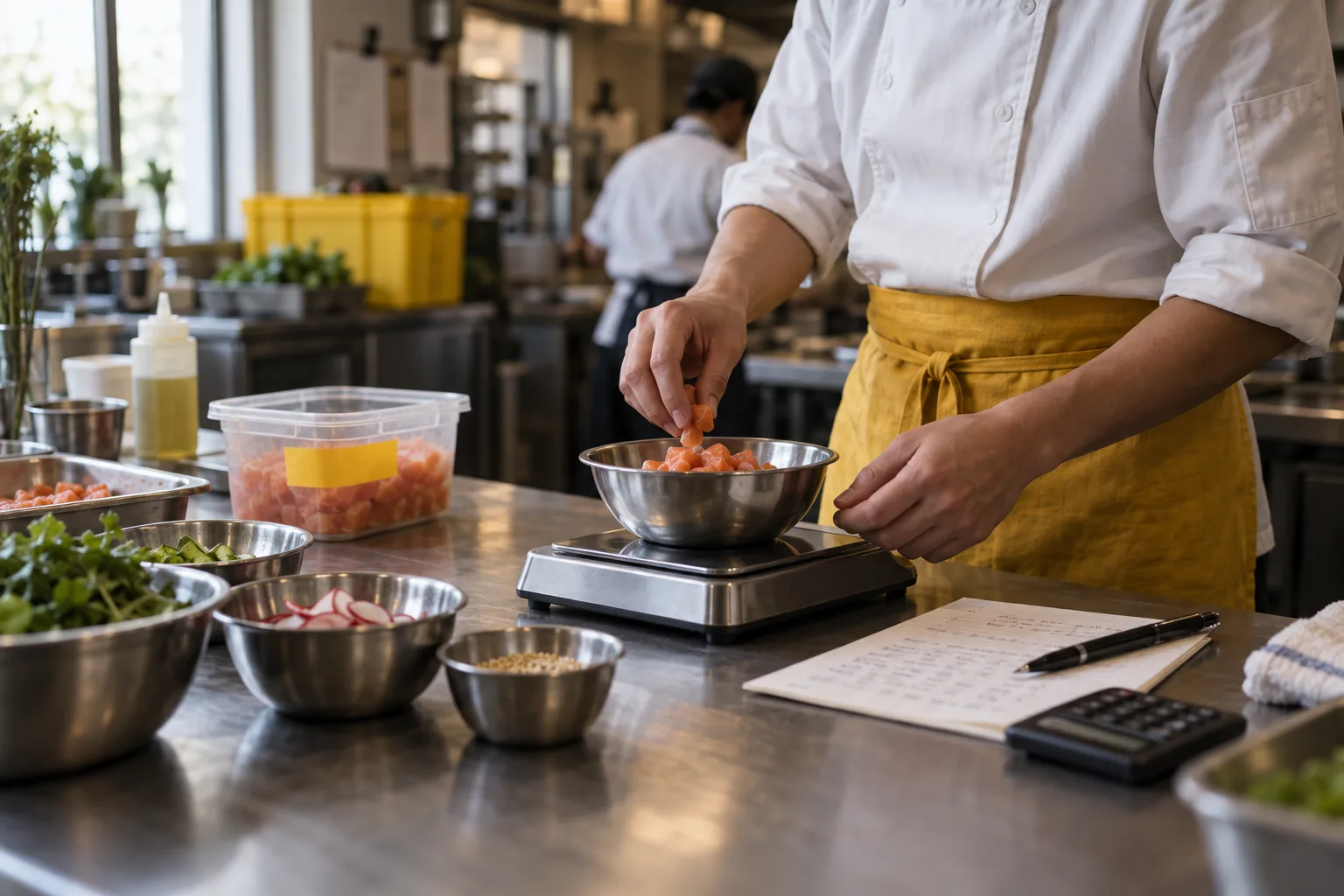
Do not trust generic tables for your top items. Weigh a case in, trim it, weigh what is usable, and write the number down. Ten minutes per item, for the twenty ingredients that drive most of your cost.
Cooking loss is yield too. A 200 g raw burger patty weighs about 150 g cooked. If your portion spec is 150 g cooked, you cost 200 g raw.
Worked example: grilled salmon with potatoes and greens
Menu price: $26.00. Column letters match the template above.
| Ingredient | Purchase price (C) | Yield (D) | Usable cost (E) | Portion (F) | Line cost (G) |
|---|---|---|---|---|---|
| Salmon side, skin on | $19.50 / kg | 88% | $22.16 / kg | 170 g | $3.77 |
| Baby potatoes | $2.40 / kg | 95% | $2.53 / kg | 180 g | $0.45 |
| Green beans | $6.80 / kg | 90% | $7.56 / kg | 80 g | $0.60 |
| Butter | $9.20 / kg | 100% | $9.20 / kg | 25 g | $0.23 |
| Lemon | $0.45 each | 100% | $0.45 | 0.25 | $0.11 |
| Capers, drained | $14.00 / kg | 100% | $14.00 / kg | 10 g | $0.14 |
| Parsley, picked | $18.00 / kg | 60% | $30.00 / kg | 5 g | $0.15 |
| Olive oil, salt, pepper (allowance) | $0.20 | ||||
| Plate cost | $5.65 |
Food cost percentage: $5.65 divided by $26.00 is 21.7%, a comfortable number for a protein-led main.
Now watch two things drift:
- The line cook portions salmon at 190 g instead of 170 g, which happens without a scale. The salmon line becomes $4.21 and plate cost $6.09.
- The supplier moves salmon from $19.50 to $21.50 per kg over two quarters. Usable cost becomes $24.43 per kg, and at 190 g the line is $4.64, plate cost $6.52.
Food cost on the dish is now 25.1%. The plate looks the same and the menu says the same, and you keep $19.48 per plate instead of $20.35. On 400 salmon plates a month that is $348 gone without anyone deciding to spend it.
Target food cost by dish type
A single target across the menu is wrong. Dishes do different jobs:
- Protein mains: 28 to 35%; the salmon above is priced lean on purpose
- Pasta, rice and vegetable mains: 18 to 25%, these carry the margin
- Starters and sides: 20 to 30%
- Desserts: 15 to 25%
- Non-alcoholic drinks: 10 to 20%
Manage the blended food cost across what sells, weighted by sales mix: a 36% steak that sells 300 a month next to a 19% risotto that sells 250 is fine. The blended number is what shows up in your P&L, and the guide to what a good food cost percentage is has benchmarks by concept.
The menu price formula
Starting from a target food cost and a plate cost:
Menu price = plate cost / target food cost %
For the salmon at $5.65 and a 25% target: $5.65 / 0.25 = $22.60. Priced at $26, you have a buffer. Treat the formula as a floor; the market and the rest of your menu set the final number.
The reverse works too. If a competitor charges $22 for a comparable salmon and you want to match, your plate cost needs to land at or under $5.50 at 25%. That tells you whether to trim the portion, swap the side, or leave the dish at $26 and let it be the premium option.
When to re-cost
Recipes go stale faster than you expect. Re-cost when:
- A top-20 ingredient moves more than 5% in price
- You change a supplier or a pack size
- The portion spec changes, on paper or on the line
- Each quarter, for the whole menu
The quarterly re-cost is where most restaurants fall down. It costs a day in a spreadsheet because someone has to look up each price again, while supplier price increases that change plate cost without anyone noticing pile up between passes. If prices flow into the recipe from invoices, the re-cost is a report you read, and the salmon example gets flagged the week the supplier moves rather than the quarter after.
Three mistakes to avoid
- Costing at the purchase price with no yield. Protein and most produce lines come out understated.
- Costing the recipe once and leaving the prices to age. A recipe costed in January is wrong by June.
- Costing the written spec while the plate drifts. Weigh ten plates during a real service. If the average runs 12% over spec, cost that number and fix the portioning.
A note on tools: keeping costs current from invoices
A spreadsheet works for the first costing of a 40-item menu and stops working at the re-costing stage, because keeping 200 ingredient prices current by hand is a job that slips by the second month. We built bilz so the invoice does the typing: line-level OCR reads each delivery, the new price lands on the recipe card, plate cost and food cost percentage update on their own, and dishes that cross a threshold get flagged before the month closes (how it works, $149 per location per month). Whatever tool you use, the recipe costing template above is the structure; the discipline is keeping it current.
Frequently asked questions
How do you calculate the cost of a recipe?
List each ingredient at its latest invoice price, divide by yield percentage for usable cost, multiply by portion quantity for the line cost, then add the lines plus a small allowance for seasoning and pan oil. The total is the plate cost; the salmon example above shows each step.
What is the formula for food cost per dish?
Food cost per dish is plate cost divided by menu price, expressed as a percentage. The salmon plate at $5.65 on a $26.00 menu price is 21.7%. Track it per dish and as a blended figure weighted by sales mix.
How do you price a menu item from its cost?
Menu price equals plate cost divided by target food cost percentage. A $5.65 plate at a 25% target gives $22.60, the floor. Round to the price point that fits the menu and the market, then check the blended food cost still lands where you want it.
What is yield percentage and how does it change cost?
Yield is the share of a purchased item you can serve after trimming, peeling and cooking loss. A whole chicken at $3.60 per kg with 55% yield costs $6.55 per usable kg, and the recipe has to carry that number. Skipping yield understates most protein and produce lines by 10 to 45%.
How often should recipes be re-costed?
Re-cost a dish when a top-20 ingredient moves more than 5%, when a supplier or pack size changes, and when the portion spec changes. Re-cost the full menu each quarter. If invoice prices feed your recipes as deliveries arrive, the quarterly pass becomes a review of exceptions.