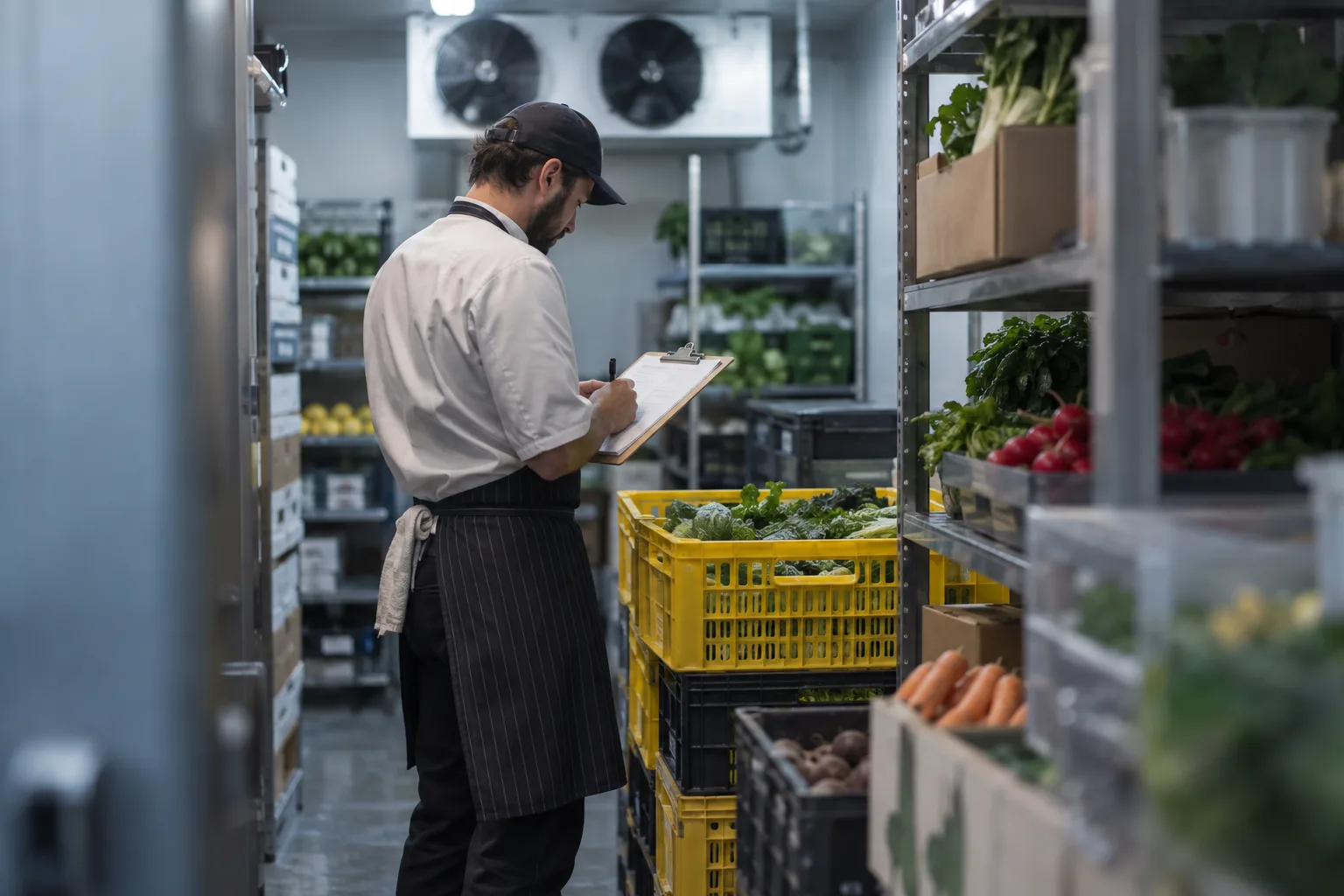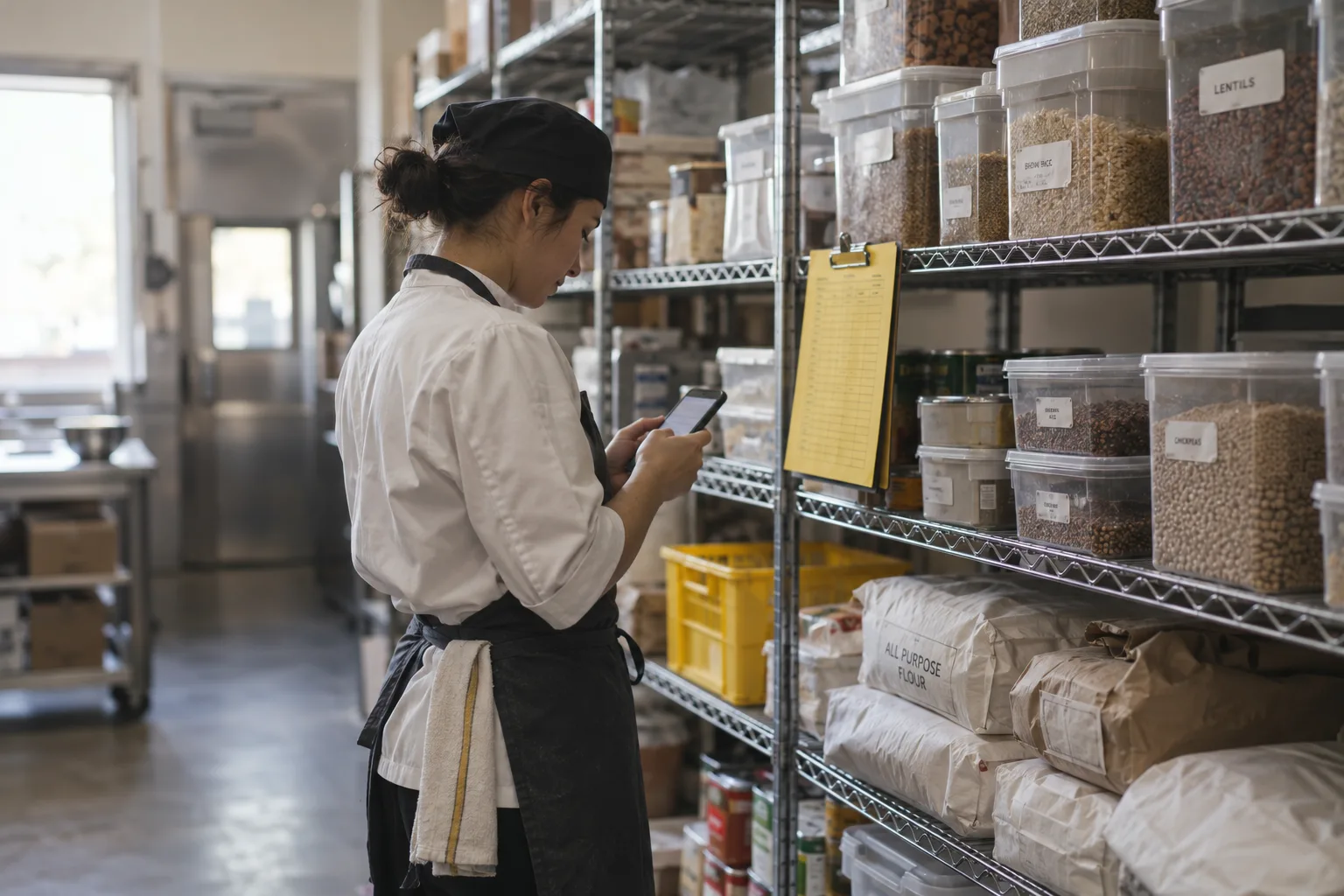
Most restaurants get stock counts wrong for one reason: the count takes too long, so it happens once a month at best, so the team stops trusting the numbers, so you skip the next one. This guide covers how to take inventory in a restaurant with a blind stock count that fits in 30 minutes, the procedure we see working in kitchens from 40 to 200 covers, on paper or on a phone.
What “blind” means and why it beats counting against expected quantities
In a blind inventory count, the person counting does not see the expected quantity. The sheet says “Chicken thigh, kg” and an empty box, with no “expected 14.2” beside it.
Show a counter the expected number and they anchor to it: a glance at the walk-in, about a case, write 14. Hide it and they weigh the tub and write 11.6. The 2.6 kg gap is the whole reason you count.
A blind count also removes the temptation to correct a figure that looks wrong. A figure that looks wrong is information, and you want it on the sheet.
Before you start: deliveries, layout, units
Set these up once.
Fix the count order to the physical layout. Your list should follow the path a person walks: walk-in left to right, top shelf to bottom, then dry store, then bar, then line. An alphabetical list means walking between the freezer and the shelf fifteen times. Spend 45 minutes once putting items in shelf order (Toast calls this shelf-to-sheet) and each count after that runs faster.
Decide the counting unit per item and write it down. “Tomatoes” is not a unit. Pick one per item and keep it:
- Weight items (meat, fish, cheese, produce): kg or lb, weighed
- Case items (cans, beverages, dry goods): cases plus loose units
- Open containers (oils, sauces, spirits): tenths, by eye or by weight
Tenths for open bottles is good enough; 0.3 versus 0.4 on a litre of olive oil is not where your money is.
Count right after close or before deliveries. The count is a snapshot, and a line pulling product mid-shift blurs it. Count after close, before the cleaning crew rearranges the walk-in, or first thing in the morning before the first delivery lands. If a delivery arrives mid-count, note what came in and leave it out.
How to take inventory in a restaurant: the 30-minute procedure
Minutes 0 to 2: set up
Print the restaurant inventory count sheet in shelf order, or open the count on a phone. Confirm the expected column is hidden and that no delivery is due during the window.
Minutes 2 to 25: two people, one path, no talking
One person counts and calls out, the other records. The recorder does not count and the counter does not write. Move through the shelf order without skipping. If something is missing from the list, note it at the end rather than hunting for it. With two people and a sensible path, a 150-item kitchen count takes 20 to 25 minutes.
Minutes 25 to 28: submit before looking at anything
Enter the count, then run the variance report. If someone wants to check the chicken again, they can, but the original number stays on record next to the recount.
Minutes 28 to 30: scan the top ten variances by value
Look at the ten biggest variances by value before the next service; a count reviewed three days later gets no action. Most will have a plain explanation: a delivery not received into the system, a transfer to the other site, a recipe mapped to the wrong unit. Chase the ones without one.
Count sheets versus phone
Paper count sheets still work. They carry two costs: the transcription afterwards (15 to 30 minutes of typing, with a few errors), and the delay between counting and seeing variances.
Counting on a phone, in shelf order, with expected quantities hidden, removes both. The count goes live the moment you enter the last item, and the variance is readable before the counter has taken their apron off. Voice entry (“chicken thigh eleven point six”) beats typing when hands are cold or wet, which in a walk-in is most of the time.
If you stay on paper, print the sheet in shelf order and leave the expected column off.
How often to count what: daily, weekly, monthly
Counting everything daily wastes time; counting everything monthly is too slow to catch problems. Split the list by value and risk:
| Group | What goes in it | Frequency | Typical item count |
|---|---|---|---|
| A: high value or high risk | Proteins, seafood, spirits, cheese, specialty produce | Daily or every other day | 15 to 25 items |
| B: medium | Dairy, beer, wine, prepared sauces, oils | Weekly | 40 to 60 items |
| C: low | Dry goods, cans, paper, cleaning | Monthly | Everything else |
Group A is about 20 items and 60 to 70% of your food cost. Counting it daily takes eight minutes and catches most of the problems worth catching. The full count (A plus B plus C) is the monthly one, and it feeds your actual food cost calculation.
Variance thresholds: when to act
Set thresholds by value as well as by percentage, because 20% of a $3 item is noise and 3% of $900 of beef is a conversation.
A workable rule for a single-location restaurant:
- Flag any item with a variance above $25 in the period
- Flag any item with variance above 5% of usage, whatever the value
- Investigate anything flagged twice in a row
Over a month, a well-run kitchen lands at total variance of 1 to 2% of purchases. Between 2 and 4% is normal for a kitchen in its first months of counting. Above 4% points to an unreliable count (mixed units, deliveries not received into the system) more often than to real loss, so fix the process before you blame the team. For the formula and the five root causes, see acceptable inventory variance after a count.
Why a count takes 90 minutes instead of 30
- The list is alphabetical, or in the order someone set it up two years ago
- Units are inconsistent, so the counter stops to ask
- Stock sits in three places and the list does not say which
- The expected quantity is visible and people argue with it
- Counting happens mid-shift and gets interrupted
- Paper, then typing, then checking the typing
Fix the first three and most of the time disappears.
A worked example
A 90-seat bistro with a 160-item list. Before: monthly count, alphabetical paper sheet, two hours including data entry, no variance review.
After reorganising the list in shelf order and splitting it into A, B and C groups:
- Daily A count: 22 items, 7 minutes, one person
- Weekly B count: 55 items, 15 minutes, two people
- Monthly full count: 160 items, 28 minutes, two people
Total counting time per month went from 2 hours to about 4.5 hours. Variance on proteins went from an unknown figure to 1.8% within two months, because somebody looked at the numbers each morning. On $18,000 of monthly protein purchases, the owner noticed.
Where software fits
Software earns its place in two spots: hiding the expected column, and posting purchases without anyone typing them. If invoices get scanned at delivery, purchases are already in the system when you count, and a phone count in shelf order produces the variance report before you leave the building. Check for mobile counts in shelf order, a blind mode and line-level invoice capture (feature list); the restaurant inventory software buyer’s checklist covers the rest.
This is how we run it at bilz: shelf-ordered mobile counts, blind by default, invoice OCR posting purchases as deliveries land, and a variance view the next morning, at $149 per location per month. The procedure above works on paper too. Start there if you have to.
Frequently asked questions
What is a blind inventory count?
A blind inventory count hides the expected quantity from the person counting. They record what they weigh or see, and the system compares that against the book quantity afterwards. Hiding the number stops counters anchoring to it.
How often should a restaurant take inventory?
Count high-value, high-risk items (proteins, seafood, spirits, cheese) daily or every other day, medium-value items weekly, and the full list monthly. The monthly count feeds your food cost percentage; the daily A-list catches problems while you can still act on them.
How long should an inventory count take?
With a shelf-ordered list, fixed units and two people, a 150-item kitchen takes 20 to 25 minutes. A daily A-list of 20 items takes under ten minutes for one person. If a full count runs past an hour, fix the list order and the units first.
Should you count before or after a delivery?
Before. Count after close or first thing in the morning, ahead of the first delivery. If one arrives mid-count, note what came in, leave it out of this count, and receive it into the system on its own so purchases and counts line up.
Do I need to weigh open containers?
Weigh proteins, cheese and anything else you buy by weight. Estimate open bottles of oil, sauce and spirits in tenths by eye; the extra precision is worth less than the time it costs.